
Growth Marketing vs Traditional Marketing
- shivanshpathak0001
- Jun 12
- 2 min read

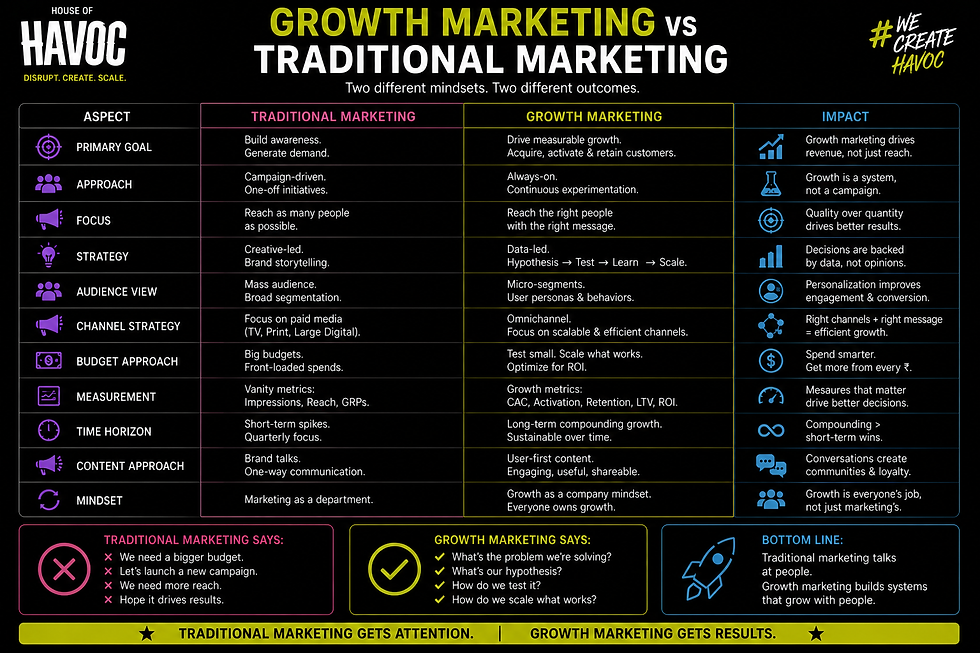
Marketing has changed dramatically over the last decade.
While the goal of attracting customers remains the same, the way businesses approach growth has evolved significantly. One of the biggest changes has been the rise of growth marketing—a strategy designed to optimize the entire customer journey rather than focusing solely on visibility and awareness.
To understand why this matters, it's important to compare growth marketing with traditional marketing.
Traditional marketing typically focuses on generating awareness.
The objective is to get a brand, product, or service in front of as many people as possible.
Success is often measured through metrics such as impressions, reach, media exposure, and campaign visibility.
These metrics are valuable because awareness is the first step in any customer journey.
However, awareness alone doesn't guarantee business growth.
This is where growth marketing takes a different approach.
Instead of focusing exclusively on attracting attention, growth marketing examines every stage of the customer lifecycle. The goal is not simply to generate visibility but to create measurable and sustainable business outcomes.
Growth marketers ask questions such as:
Did the campaign generate customers?
Did those customers return?
Did they refer to others?
Did revenue increase?
Did retention improve?
Rather than evaluating success at the top of the funnel, growth marketing measures performance across the entire customer journey.
This includes:
Acquisition
Activation
Retention
Referrals
Revenue
Each stage is continuously monitored, tested, and optimized.
This is one reason businesses increasingly partner with a performance marketing agency that understands customer behavior beyond simple advertising metrics.
Another major difference is experimentation.
Traditional campaigns are often planned months in advance and executed according to a fixed strategy. Growth marketing operates differently. Growth teams constantly test messaging, channels, creative formats, audience segments, and user experiences to identify opportunities for improvement.
Small optimizations can produce significant long-term gains.
For example, increasing a landing page conversion rate by a few percentage points or improving customer retention can have a substantial impact on overall business performance.
Technology plays a critical role in this process.
Modern analytics platforms provide detailed insights into customer behavior, allowing marketers to make data-driven decisions rather than relying on assumptions. This creates a faster feedback loop and enables continuous improvement.
That said, growth marketing and traditional marketing are not competitors.
The most successful brands combine both approaches.
Traditional marketing helps create awareness, trust, and emotional connection. Growth marketing ensures that awareness translates into measurable business outcomes.
At House of Havoc (HOH), we believe sustainable growth requires both brand building and performance optimization. As a modern digital marketing agency, we help brands combine creators, communities, content systems, and growth strategies to create long-term business value.
Whether working with the best digital marketing agency or partnering with an outsourced marketing agency, businesses should avoid viewing awareness and growth as separate priorities.
The strongest marketing systems integrate both.
Because attention may open the door.
But growth happens when every stage of the customer journey is working together.
And that's exactly what growth marketing is designed to achieve.
Comments