
What Is Integrated Marketing?
- shivanshpathak0001
- Jun 13
- 2 min read

Many businesses invest in multiple marketing activities but still struggle to achieve consistent results.
The reason is often not a lack of effort.
It's a lack of alignment.
The social media team focuses on engagement.
The advertising team focuses on conversions.
The content team focuses on publishing.
The events team focuses on attendance.
Each activity may perform well individually, yet the overall marketing system remains fragmented.
This is where integrated marketing becomes essential.
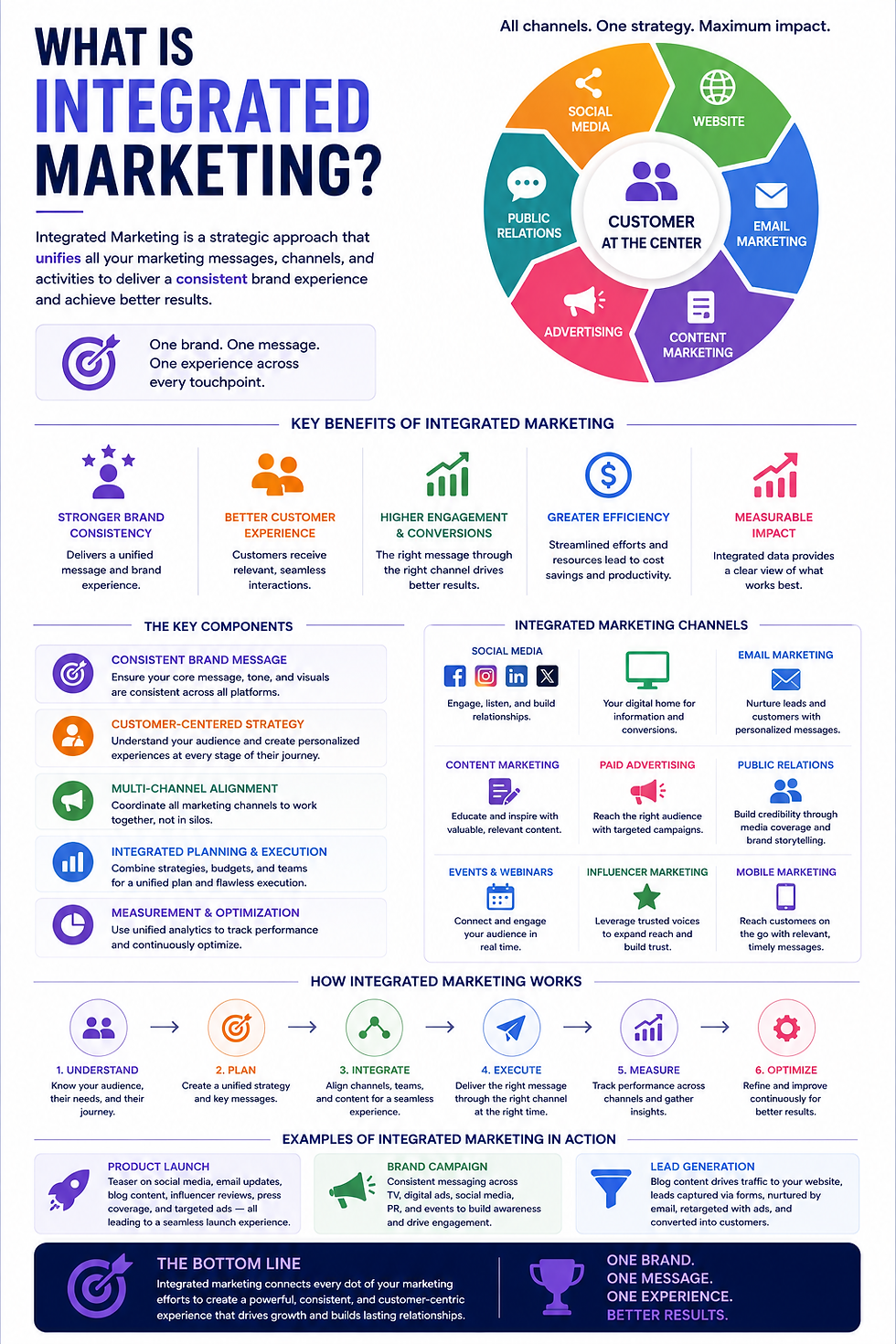
Integrated marketing is the practice of aligning all marketing activities under a single strategy. Instead of treating channels as separate initiatives, businesses create coordinated systems where every activity contributes to shared goals.
The objective is simple:
Make every marketing effort work together.
This is why every modern digital marketing agency should think beyond channels and focus on creating connected growth systems.
Consumers do not experience brands through isolated departments.
They experience brands through journeys.
A customer may discover a company through social media, visit its website through a search engine, join a community, attend an event, receive emails, and eventually make a purchase.
From the customer's perspective, these interactions are part of a single relationship.
Integrated marketing ensures that relationship feels consistent.
One of the biggest advantages of integrated marketing is efficiency.
When channels support one another, businesses generate greater value from every marketing investment.
For example:
Content improves SEO visibility.
Creators amplify content reach.
Events generate creator content.
Communities strengthen engagement.
Performance campaigns distribute high-performing assets.
Email marketing nurtures relationships.
Each activity reinforces the others.
The result is a marketing system that becomes stronger over time rather than a collection of disconnected campaigns.
Content provides a good example of how integration works.
A single piece of content can support search visibility, social media engagement, creator collaborations, community discussions, email campaigns, and advertising efforts.
Instead of creating separate assets for every channel, brands maximize value by designing content with distribution in mind.
This creates greater efficiency while improving consistency.
Creators also play an important role.
Rather than functioning as standalone promotional channels, creators can become part of a larger ecosystem. Creator-generated content can support social media strategies, paid advertising campaigns, community engagement initiatives, and event activations.
The same principle applies to experiential marketing.
Events are no longer isolated experiences. A single activation can generate content, creator partnerships, community participation, media coverage, and customer acquisition opportunities.
When viewed through an integrated lens, every activity creates value beyond its immediate objective.
Measurement improves as well.
Many businesses struggle to understand how different marketing channels contribute to business outcomes. Integrated marketing provides greater visibility into the customer journey, making it easier to identify which touchpoints influence awareness, engagement, conversions, retention, and advocacy.
This allows organizations to make better strategic decisions.
At House of Havoc (HOH), integrated marketing forms the foundation of everything we do. As a growth-focused digital marketing agency, social media marketing agency, and performance marketing agency, we help brands combine creators, communities, content systems, experiential campaigns, and performance channels into unified growth ecosystems.
Because the strongest brands no longer think in channels.
They think in systems.
They think in journeys.
And most importantly, they think in ecosystems that continue creating value long after individual campaigns have ended.
That's what integrated marketing is all about.
Comments